Curved Staircases for Custom Homes: Design, Cost, and Engineering

Curved Staircases for Custom Homes Design, Cost, and Engineering

In the luxury housing market, curved staircases for custom homes are gaining momentum.

A curved stairway sets the tone the second someone walks in. The best curved stairs feel effortless: a smooth sweep, open space, clean lines, and railings that stay out of the way while still feeling substantial.

If you are drawn to modern curved stairs, two choices usually define the entire look: open risers and a mono-stringer or mono-beam structure, paired with clean railings like glass, plain metal, or modern-style handrails. Southern Staircase designs and builds curved stair systems where engineering and craftsmanship work together, using advanced CAD, precise measurement workflows, and coordinated fabrication across wood, steel, and glass components.

Whether you are a luxury home builder or homeowner, get ready to be the talk of the town with a custom curved stairway like no other.

Key Takeaways on Open Riser and Mono-Stringer Curved Stairs

  • Open risers make curved staircases feel lighter, brighter, and more architectural.
  • Mono-stringers create a dramatic floating look, but curves and longer runs often require extra structural planning.
  • Clean railings like glass and minimalist metal handrails keep the curve as the focal point.
  • Staircase cost is driven by geometry, materials, railing complexity, and coordination across trades, not just “stairs vs. no stairs.”
  • The best curved staircases are engineered early, with load, deflection, and code requirements baked into the design from day one.


Why Do People Choose Curved Staircases for Custom Homes?

  • Curved staircases do something straight stairs cannot: they guide the eye. A well-designed curve creates a natural flow through the entry and into the main living space, which is why curved stairs often become the signature element in high-end builds.
  • Modern luxury clients are asking for a “less is more” look. That is where open risers and clean railings come in. Instead of heavy balusters and visual clutter, the curve stays sculptural, and the space stays open.


Southern Staircase builds curved stairs as functional focal points, and their curved stair systems are positioned as design-forward centerpieces for custom homes and commercial spaces alike.

Design Choice 1: Open Risers for a Lighter, Floating Feel

Open risers are a modern favorite because they:

  • Increase sightlines
  • Help natural light travel
  • Make the staircase feel like it belongs to the architecture instead of blocking it


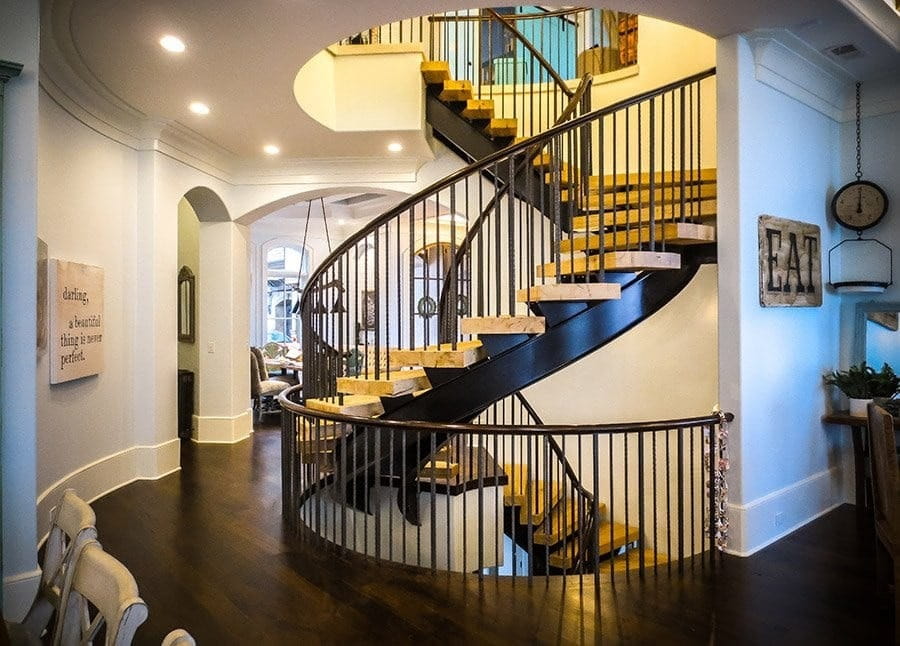
For curved designs, open risers do even more visually: they emphasize the staircase’s sweep and reduce the “mass” that can make curves feel bulky.

Southern Staircase highlights open riser stairs as a contemporary, airy design that creates unobstructed views, and designs open riser systems in a variety of materials, with handrail options tailored to the project.

Practical note for luxury homes: open risers are not just an aesthetic decision. They influence guard and railing strategy, lighting, and how the staircase reads from multiple angles.

Design Choice 2: Traditional Closed Risers on Curved Stairs for Custom Homes

Closed risers give a curved staircase a more substantial, tailored look. Instead of seeing daylight between treads, you get a continuous sweep that reads clean, finished, and intentionally architectural. In luxury custom homes, closed riser curves are often the right choice when you want the staircase to feel like a true centerpiece, not just a light, floating element.

From a design standpoint, closed risers make the curve feel smoother and more “built-in.” They hide under-structure details, reduce visual noise, and create a strong silhouette from every angle, especially in grand foyers where the stairs are visible from multiple rooms.
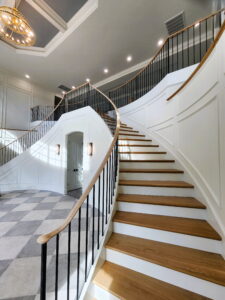
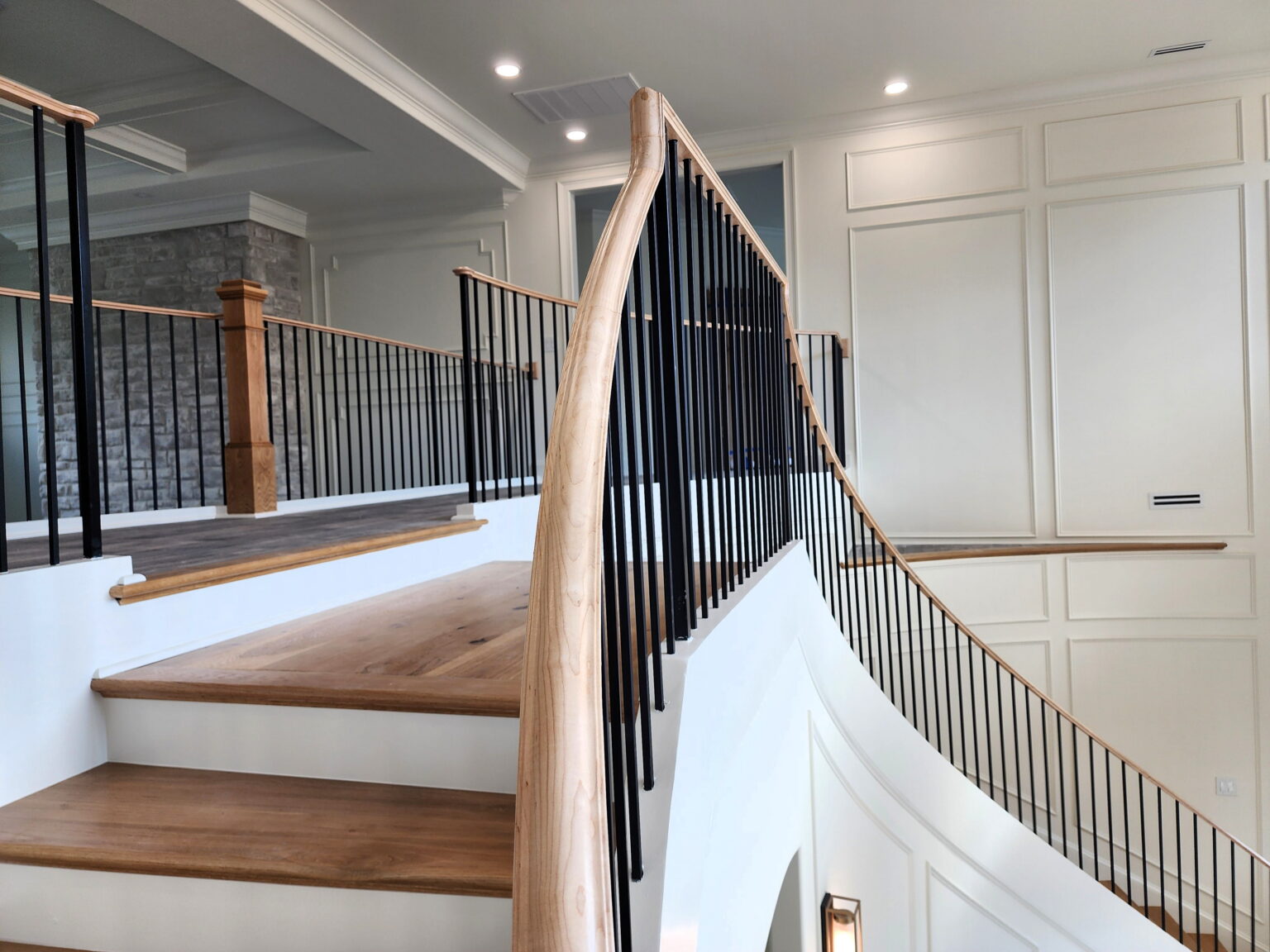
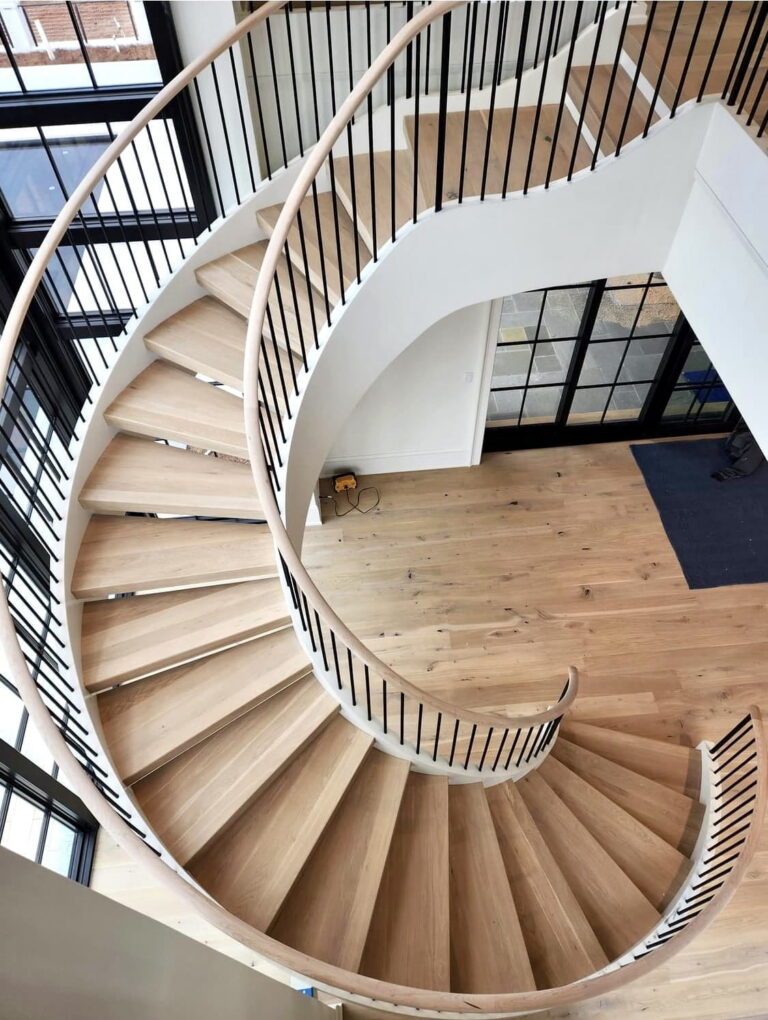
Grand Staircase Bottom View: Maple Dixie Cap rail profile, plain 1/2" balusters, and metal newels

Closed risers also open up more styling options:

  • Refined profiles and trim details: You can add subtle tread returns, clean skirt boards, and tight edge lines that emphasize craftsmanship without looking ornate.
  • Bold material moments: Closed risers pair beautifully with stained hardwood treads, painted risers, or a two-tone palette that matches your millwork and wall color.
  • A cleaner backdrop for modern railings: Glass panels and minimalist metal handrails pop even more when the stair beneath them looks continuous and polished.


On the practical side, closed risers can feel quieter in daily use. Many homeowners prefer the sense of privacy and solidity, especially in main living areas, where open risers can create sightlines they do not want. Closed risers are also a smart option if you want a curved staircase that feels more traditional in structure, but still modern in finish and railing style.

Design tip for luxury homes: If you want the best of both worlds, keep the staircase body clean and substantial with closed risers, then go modern on the details. Use a crisp stair handrail profile, slim metal components, or glass to keep the overall look fresh and high-end.

Design Choice 3: Clean Railings That Let the Curve Lead

In luxury homes, “clean railings” usually mean the railings support the design without becoming the design. Three options dominate modern curved builds:

Glass railings

Glass is the clearest path to a “floating” look because it preserves the sightline through the curve. Southern Staircase positions its glass railing systems as code-compliant, durable, and supported by reliable hardware for stability.

Plain metal and stainless steel details

Minimal stainless steel railings and modern handrails keep edges crisp and intentional. Southern Staircase has long highlighted glass and metal as a modern pairing that makes a strong architectural statement while remaining visually simple.

Modern handrail styling

A modern handrail can be the finishing detail that makes the whole system feel “custom,” especially on a curve where the rail becomes a continuous line.

Design tip: On curved stairs, the rail is one of the first things you see. A clean, continuous profile with carefully planned transitions matters as much as tread material.

Engineering Considerations That Matter on Curved Staircases for Custom Homes

Curved staircases are not “bent straight stairs.” The geometry changes how loads move through the structure, and the build demands precision.

Read the Southern Staircase whitepaper on core engineering of curved stairs:

  • Live load calculations
  • Lateral loads
  • Deflection limits
  • Material selection
  • Building code compliance


A few factors that consistently drive engineering decisions on modern curved stairs:

  • Deflection control: curves and longer spans must feel solid underfoot, not springy. Deflection planning is part of the design, not a last-minute fix.
  • Structural integration: curved stairs should be engineered into the home early so attachment points, supports, and surrounding framing align cleanly.
  • Precision measurement and modeling: Southern Staircase describes using advanced CAD, plus tools like laser scanning and 3D mapping, to translate site conditions into buildable designs.
  • Coordination with specialized vendors: curved glass, steel forming, and custom metalwork often require close coordination with specialized partners.


Cost Drivers: What Makes a Curved Staircase More Expensive?

Curved stairways typically cost more because they require more engineering, more fabrication time, and more detailed coordination.
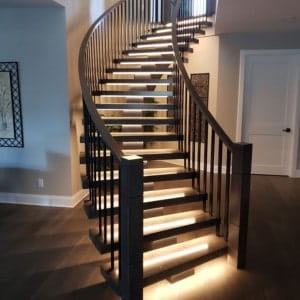
LED Lights on Curved Staircases for Custom Homes

Common cost drivers include:

  • Curve complexity: tighter radii, multi-story curves, landings, and transitions increase fabrication difficulty.
  • Structural design: the tighter the curve, such as in spiral stairs, and longer spans often require more advanced engineering to keep everything rigid and comfortable underfoot.
  • Railing scope: curved glass panels, premium hardware, and clean, minimal posts can raise both material cost and installation complexity.
  • Materials and finishes: tread species, custom stains, steel finish requirements, and specialty details all affect price.
  • Lighting integration: LED in treads, under handrails, or concealed channels is a premium upgrade that should be planned early.

Cost considerations for stair glass railings are:

  • Glass type and thickness needed for the design and code requirements
  • Curved vs. straight glass: curved glass is more specialized and typically costs more
  • Hardware and mounting method: standoffs, base channels, and top rails change both price and appearance
  • Field measurements and templating: precision is critical, especially on curves
  • Install access: tight sites, tall foyers, and finished floors can increase labor time


The easiest way to protect the budget without losing the luxury look is to keep the design clean: fewer transitions, a clear railing strategy, and a layout that works with the home’s structure rather than against it.
Q&A: Curved Staircases for Custom Homes

Q: Are curved stairs popular in custom homes?
A:
Yes. They add a sense of luxury and grandeur.

Q: How much does a curved staircase cost in a luxury custom home?
A:
Cost depends on the radius and complexity of the curve, tread materials, railing type (especially curved glass), and whether lighting is integrated.

Q: Are curved staircases harder to engineer than straight stairs?
A:
Yes. Curved stairs require specialized engineering that accounts for live loads, lateral loads, deflection limits, material selection, and building code compliance.

Q: Do open risers work well on curved staircases?
A:
Yes. Open risers are popular because they create an airy look and preserve sightlines, which complements the sweep of a curved design.

Q: Can a curved staircase still be luxurious with traditional closed risers?
A:
Yes. If your home has a more traditional design, or you prefer the look of closed risers, this style looks equally elegant on a curved staircase.  

Q: What railing looks best on a modern curved staircase?
A:
Glass railings maximize openness and keep the curve as the focal point. Minimal metal and modern handrails also work well when you want a clean, architectural finish.

Q: How early should a curved staircase be designed in a custom home build?
A:
As early as possible. Curved stairs should be engineered into the home’s structure from the outset to ensure seamless integration and durability.

Q: Can you integrate LED lighting into curved stairs and railings?
A:
Yes. LED lighting can be incorporated into treads, handrails, and concealed channels when planned during design, since integration adds both design and engineering considerations.

Your Luxury Curved Staircase Awaits: Get Started Now

If your custom home deserves a true centerpiece, make the staircase the moment everyone remembers. Bring Southern Staircase your inspiration, floor plan, and finish vision, and let’s engineer a curved, open-riser statement staircase with clean railings that look impossibly light and feel rock-solid every single step.

Share this blog
LinkedIn
Facebook